Notable US Installations
Key characteristics
- Uses standard solar panels and infrastructure
- Runs more efficiently than land-based due to temperature buffering effects
- No land ownership / leasing costs (land constraints often a key driver in SE Asia)
- Provides higher energy density (1.75-2.25 acres/MW FPV vs. 5-10 acres/MW land-based)
- Often integrated with baseload generation (e.g. hydro, natural gas, coal)
Examples (US)
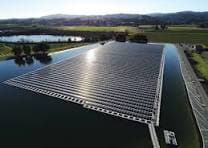
- Healdsburg, CA 4.7 MW
- Gray water storage pond
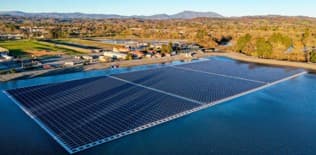
- Windsor, CA 1.8 MW..
- "Recycled" water pond
- Park City, UT 0.6 MW
- Raw Water Storage Pond
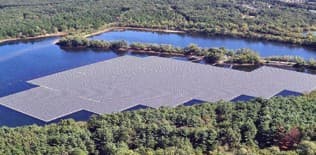
- Sayreville, NJ, 4.4 MW
- Raw water storage pond
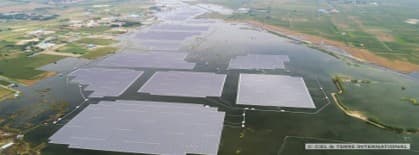
Larger International Installations
Additional characteristics
- Reduced evaporation saves critical water resources in arid regions
- Algae growth mitigation improves water quality and lowers treatment costs
- Scalable design allows for phased implementation and expansion
- Quick deployment relative to complex land-based civil engineering projects
Additional Examples
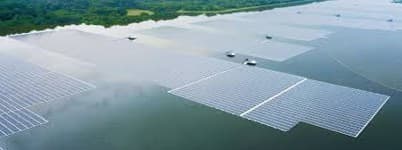
- West Java, Indonesia, 192 MW
- Hydroelectric Reservoir
- Three Gorges New Energy, China, 70 MW
- Hydroelectric Basin
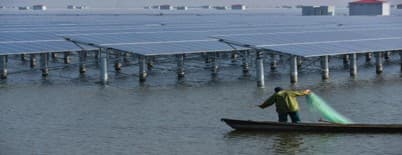
- China, 150 MW
- Aquaculture Integration
- Zhejiang, China, 200 MW
- Aquaculture Integration